In a fast-moving world where people rarely pause to reflect, a meaningful Quote of the Day can offer a moment of clarity. Philosophical quotes, in particular, go beyond simple motivation—they challenge how we think, behave, and understand ourselves.
One such powerful quote attributed to Plato continues to resonate across generations:
“We can easily forgive a child who is afraid of the dark; the real tragedy of life is when men are afraid of the light.”
This thought-provoking line explores fear, truth, and personal growth in a way that remains deeply relevant today.
Understanding Plato’s Quote
At first glance, the quote presents a simple comparison between a child’s fear and an adult’s fear. A child being afraid of the dark is natural. Darkness represents the unknown, and children often fear what they cannot see or understand. This kind of fear is innocent and temporary.
However, Plato shifts the focus to something far more serious—the fear of “light.” In this context, light symbolizes truth, knowledge, awareness, and reality. When adults fear the light, it means they are avoiding truth even when it is within reach.
This avoidance is what Plato calls the real tragedy. Unlike a child’s fear, which fades with understanding, the fear of truth can persist for a lifetime, limiting growth and preventing self-awareness.
The Deeper Meaning: Fear of Truth
Plato’s message highlights a universal human tendency: avoiding uncomfortable truths. Truth can be difficult because it challenges beliefs, exposes flaws, and demands change. As a result, many people choose comfort over clarity.

For example, individuals may ignore feedback, avoid difficult conversations, or resist new ideas that question their worldview. This fear of truth creates stagnation. Without acknowledging reality, personal growth becomes impossible.
Plato suggests that true wisdom begins when we confront the light instead of running from it. Facing truth may be uncomfortable at first, but it leads to understanding, confidence, and long-term growth.
Lessons on Courage and Growth
This Quote of the Day is ultimately about courage. Courage is not just about facing danger—it is about facing reality. It takes strength to admit mistakes, question assumptions, and accept change.
Self-awareness is a key outcome of this courage. When people allow themselves to see the truth, they gain a clearer understanding of their strengths and weaknesses. This awareness becomes the foundation for improvement.
Growth does not happen in darkness. It happens when individuals step into the light, learn from what they see, and take action. Plato’s words remind us that avoiding truth may feel safe, but it comes at the cost of progress.
Relevance in Modern Life
Plato’s quote feels especially relevant in today’s world. In an age of constant information, people often feel pressure to appear knowledgeable and confident at all times. Admitting uncertainty or lack of knowledge can feel uncomfortable.
Social media, professional environments, and even educational systems sometimes reward confidence over curiosity. As a result, people may hesitate to ask questions, admit confusion, or challenge their own beliefs.
However, Plato’s message encourages the opposite approach. True intelligence lies in curiosity, honesty, and a willingness to learn.
Whether in classrooms, workplaces, or personal relationships, embracing truth leads to better decisions and stronger connections.
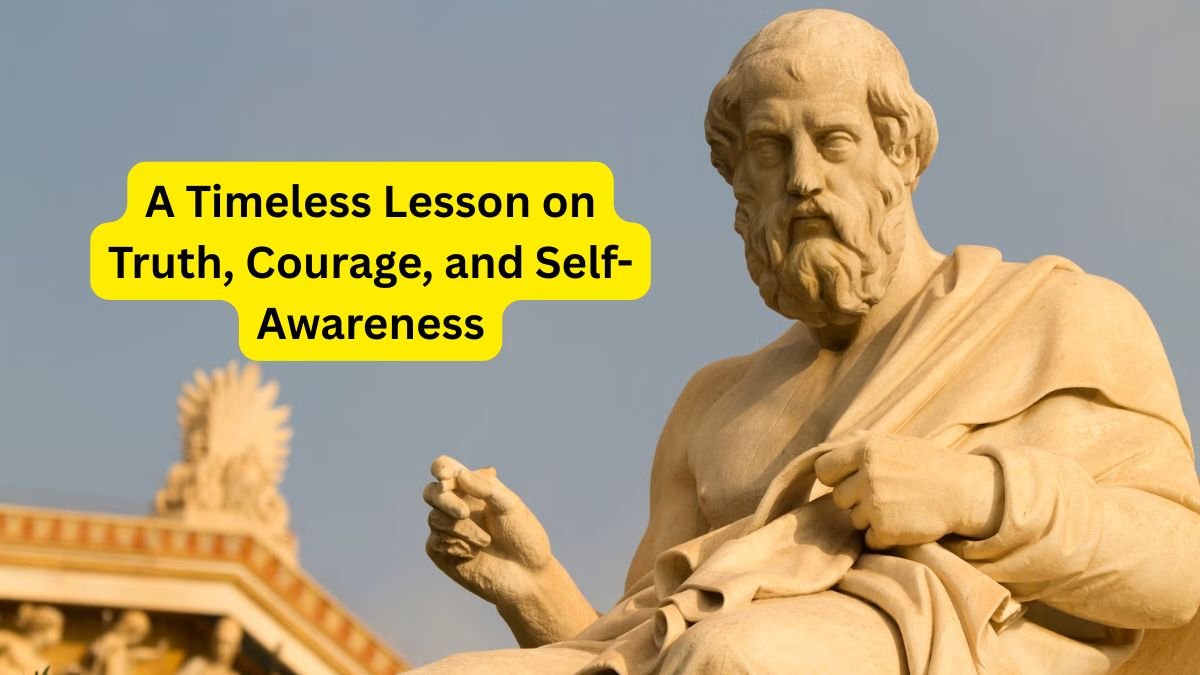
Who Was Plato?
Plato was born in Athens around 428/427 BCE into an aristocratic family. He lived during a time of political instability, which influenced his interest in justice, governance, and ethics.
Plato was a student of Socrates, whose method of questioning deeply shaped his thinking. After Socrates’ execution, Plato turned fully to philosophy, seeking answers to life’s most important questions.
Rather than presenting ideas as fixed truths, Plato wrote dialogues that encouraged readers to think critically. His works often feature Socrates engaging in discussions that explore knowledge, morality, and human behavior.
Plato’s Philosophy and Lasting Impact
One of Plato’s most important contributions is the Theory of Forms. He believed that the physical world is only a reflection of higher, unchanging truths such as Justice, Beauty, and Goodness. These truths can only be understood through reasoning and reflection.
His most famous work, The Republic, explores the concept of justice and the idea of an ideal society. It also introduces the famous “Allegory of the Cave,” which closely relates to the quote about fearing the light. In this allegory, people are afraid to leave the darkness of illusion and face the light of truth.
Plato also founded the Academy in Athens, one of the earliest institutions of higher learning. His teachings influenced generations of thinkers, including Aristotle. Today, his ideas continue to shape philosophy, politics, education, and ethics.
Other Inspiring Quotes by Plato
Plato’s wisdom extends far beyond a single quote. Some of his other well-known sayings include:
- “The beginning is the most important part of the work.”
- “A good decision is based on knowledge and not on numbers.”
- “For a man to conquer himself is the first and noblest of all victories.”
- “Wise men speak because they have something to say; fools because they have to say something.”
Each of these reflects his belief in knowledge, discipline, and thoughtful action.
The Quote of the Day by Plato delivers a powerful message about fear and truth. While fear of the unknown is natural, fear of understanding is limiting. Plato reminds us that the real tragedy is not ignorance itself, but the refusal to overcome it.
By choosing to face the light—truth, knowledge, and self-awareness—we open the door to growth and transformation.
His timeless wisdom encourages us to question, learn, and evolve, proving that true courage lies in seeking understanding, even when it feels uncomfortable.